Volume 01 · Now Available

AI playbooks for the nonprofits
doing the real work.

Practical field guides, prompt libraries, and AI systems built for under-resourced nonprofit teams who need to compete with full development departments.

58 Pages of practice
50 AI prompts
100 Verified grants
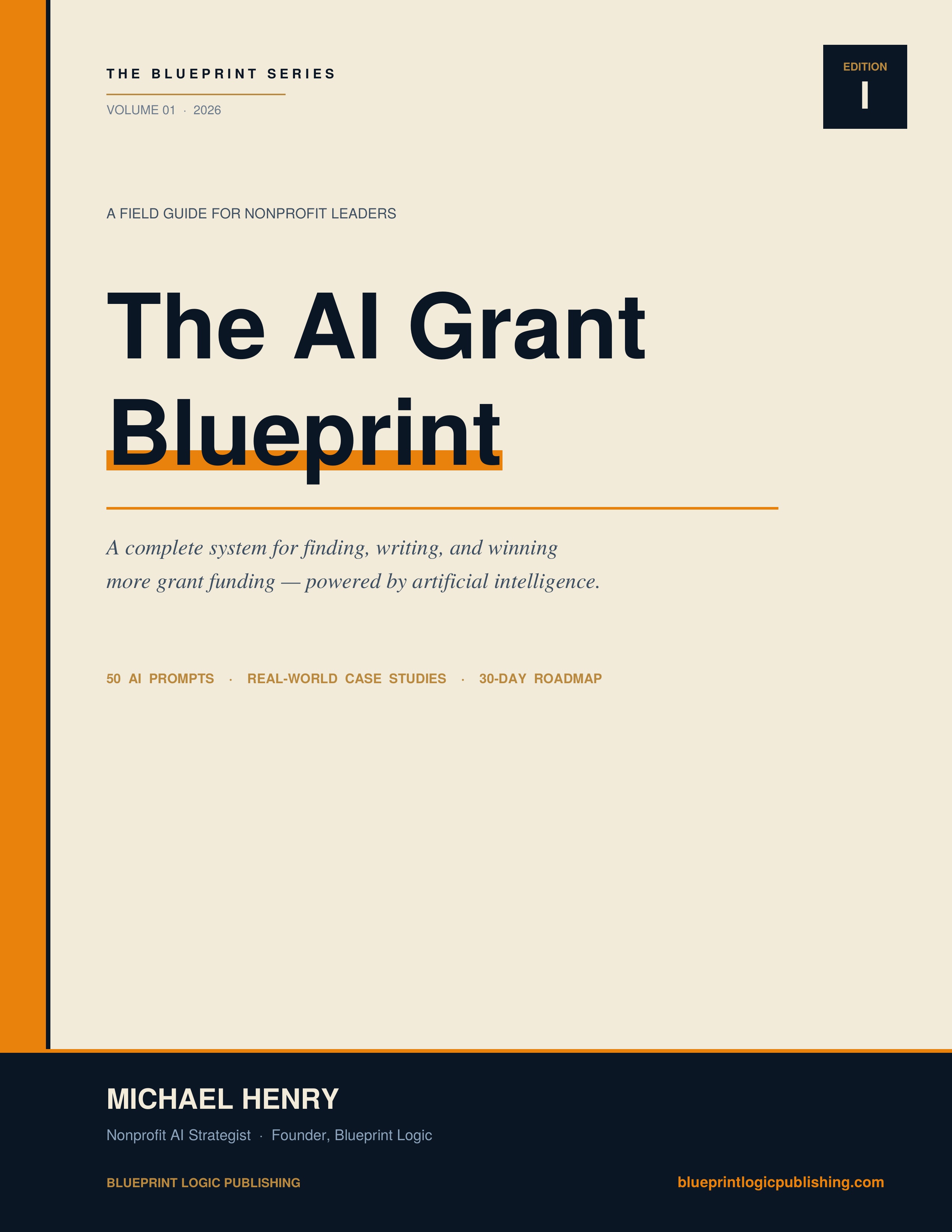
The AI Grant Blueprint — Edition I
The structural problem

You're not losing grants because
your mission isn't good enough.

You're losing because you're competing on an uneven playing field. AI changed that equation. Permanently.

What's broken

  • Over 100,000 foundations exist — finding the right ones takes weeks of manual research
  • Applications get rejected because they don't speak the funder's specific worldview
  • Documents are never ready when deadlines appear
  • Evaluation plans read as activities, not measurable outcomes
  • Budget narratives leave reviewers asking "where did this number come from?"
  • Rejections teach nothing because there's no system for learning from them

What AI enables

  • AI-powered eligibility screening surfaces funders that actually match your work
  • 990 research reveals what foundations really fund vs. what they say they fund
  • Section-by-section AI prompts produce competitive first drafts in 90 minutes
  • SMART objectives and evaluation frameworks generated from your program model
  • Complete budget narratives written line-by-line, justified and consistent
  • A reproducible system — every rejection improves the next application
Volume 01 · The Field Guide

The AI Grant Blueprint.

A complete system for finding, writing, and winning more grant funding. Built from real practice — not theory. Updated for 2026 with current Uniform Guidance changes.

01

The Foundation

The grant-readiness audit and document library framework most nonprofits skip — and lose grants because of.

02

The Research System

The ProPublica method for finding funders that match your work, not the ones everyone else is applying to.

03

The Writing Frameworks

Section-by-section AI prompts for executive summaries, statements of need, evaluation plans, and budget narratives.

04

50 Power Prompts

Every prompt organized by application section. Tested, refined, copy-paste ready for Claude or ChatGPT.

05

The Federal Playbook

Updated for 2024 Uniform Guidance — de minimis 15% MTDC, single audit $1M threshold, and every compliance change.

06

The 30-Day Roadmap

Day-by-day from reading the guide to submitting your first AI-assisted competitive application.

It produced in 20 minutes what normally took me 3 hours. My first thought was, “Am I obsolete?” She wasn’t. The AI handled the structural drafting; her expertise shaped it into something genuinely competitive. — Sarah Chen · Spark the Fire Grant Writing (2025)
Free chapter

Read Chapter 1, on us.

Drop your email and we'll send Chapter 1 of The AI Grant Blueprint straight to your inbox. The $150 billion problem, the structural disadvantages small nonprofits face, and the eight patterns that separate the funded from the rejected.

No spam. Unsubscribe anytime. We send maybe one email per month.

Beyond the guide

Services for nonprofits
who want to move faster.

When you need more than a playbook, Blueprint Logic offers four ways to put AI to work for your grant program.

AI Grant Match

$200

A one-time custom prospect report — 25 funders matched to your nonprofit's mission, geography, and budget. Delivered in 7 days.

Learn more

AI Workflow Setup

from $1,000

We build your complete grant-writing AI infrastructure: Notion workspace, customized prompt library, document templates, research workflows.

Learn more

Strategy Session

$200

60-minute call with a personalized action plan. We work through your readiness, prospects, and next 90 days using the Blueprint frameworks.

Book a session
Blueprint Logic
Blueprint Logic Publishing
About Blueprint Logic

Built for nonprofits
that can’t afford to wait.

Blueprint Logic is a publisher of practical AI playbooks and an AI workflow studio dedicated to helping small nonprofits compete with the development capacity of much larger organizations.

Founded on a simple belief: the quality of a nonprofit’s mission should determine its access to funding — not the size of its staff or administrative budget.

Read the full story →