What's inside

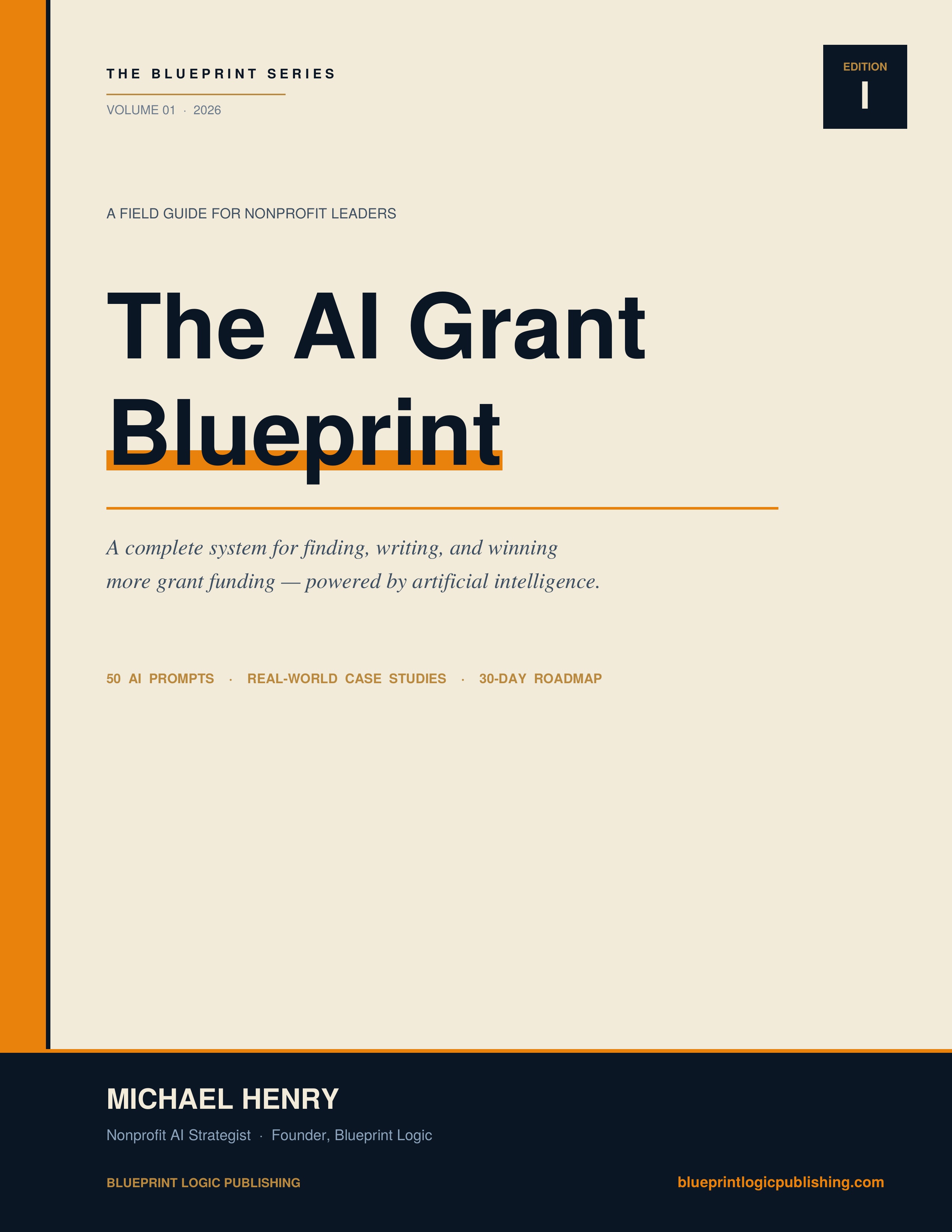
58 pages, dense with practical material.

No filler. No theoretical fluff. Every page is something you can use the same day you read it.

01

The $150B Problem

Why most small nonprofits underperform on grants — and the eight patterns that separate the funded from the rejected.

02

Getting Grant-Ready

The complete grant-readiness checklist. Documents, frameworks, infrastructure — funders check before reading your narrative.

03

Finding Grants Worth Writing

The ProPublica research method. Eligibility screening. The exact AI prompts that surface what funders really fund vs. what they say they fund.

04

Never Miss a Deadline

The 90-day calendar system, automated alerts setup, and compounding effects of running a real grant program.

05

Writing Grants That Win

Section-by-section AI prompts: executive summary, statement of need, SMART objectives, evaluation plans, capacity statements.

06

Federal Grants: Advanced

SAM.gov, program officer calls, and the 2024 Uniform Guidance changes (de minimis 15%, single audit $1M) most nonprofits haven't caught up with.

07

Foundations & Corporates

The five-step funder research protocol. Why relationships matter as much as writing — and how AI gives you time for both.

08

Budgets That Build Trust

The financial narrative that tells funders you know what you're doing. Complete budget narrative AI prompts.

09

Letter of Inquiry

The LOI structure that opens program officer relationships before competition begins.

10

Your AI Tech Stack

The free and low-cost tools that power a professional grant program. Claude vs. ChatGPT decision tree.

11+

After You Submit

Post-submission follow-up sequences. Rejection responses. Reporting that wins renewals. Building a program that lasts.

13

30-Day Action Roadmap

Day-by-day from reading the guide to submitting your first competitive AI-assisted application. Every task. Every prompt.
Bonus content included

The bonus chapters that pay for the guide twice over.

Bonus: 50 Power Prompts

Every prompt organized by application section: research, executive summary, needs statement, program design, evaluation, budget, capacity, letters, review. Copy-paste into Claude or ChatGPT. Worth more than the price of the guide on its own.

Appendix A: Templates

Organizational profile template, grant-ready scoring guide, 90-day application calendar template — fill-in-the-blank frameworks you can use immediately.

Appendix B: Glossary

25+ grant writing terms decoded: 990 forms, NICRA, CFDA, MTDC, SMART objectives, theory of change — the vocabulary that signals you're a serious grantee.

Appendix C: 100 Grants

100 verified grant opportunities by cause area: education, health, food security, housing, environment, arts, workforce, veterans, AI/tech. Award ranges, focus areas, application URLs.

Who this is for

Built for the nonprofits doing the real work.

  • Executive Directors of nonprofits under $2M budget
  • Development directors managing too many priorities
  • Program managers asked to "just write a grant for that"
  • Founders of new nonprofits building their funding strategy
  • Grant writers adding AI to their existing toolkit
Who this isn't for

Honest about what we can't do.

  • Nonprofits with $5M+ budgets and full development teams
  • Anyone looking for shortcuts or guaranteed grants
  • Organizations not ready to invest 30 days of focused effort
Real organizations · real outcomes

What nonprofits are actually doing with AI.

Pets for Patriots

80–90% time reduction on proposals. Won $30,000 grant within first month of adopting AI-assisted grant writing.

Source: FreeWill, February 2025

Environmental Nonprofit

Used AI to analyze 15 funder 990 filings. Discovered their actual competitive advantage was community engagement. Won their first foundation grant after 2 years of rejections.

Source: fundsforNGOs, 2025

Instrumentl Users

Doubled annual submission volume without adding staff. The compounding effect of running a real grant program: more apps, better data, higher win rates.

Source: Virtuous, 2026

Free chapter

Try before you buy.

Chapter 1 — “The $150 Billion Problem Nobody Talks About” — covers the eight patterns that separate funded nonprofits from frustrated ones, and how AI provides a direct solution to each one. Free to your inbox.

No spam, no salesy sequence. One email when Chapter 1 arrives, plus the occasional update.

Common questions

Things buyers ask before purchasing.

No. The 50 prompts are tested specifically for grant writing — they're structured around the actual sections funders evaluate, with the bracketed variables that matter most. But the prompts are 20% of the value. The other 80% is the system: when to use which prompt, how to verify outputs, the research method that surfaces hidden funders, the 90-day calendar, the federal compliance updates, the 100-funder list. You can't get those from a Twitter thread.

Major funders have started explicitly welcoming AI assistance. The UK's National Lottery Community Fund — distributing over £600M annually — stated clearly: “You can use AI tools to help write your funding application. We will not reject an application just because AI was used.” The Blueprint teaches the right way to use AI: as a structural drafting tool that your expertise shapes into something competitive. Never submit raw AI output — always verify and personalize.

Yes — but with realistic expectations. The guide includes a chapter on capacity statements for young organizations. Smaller foundation grants and community foundations are very accessible for new nonprofits. Federal grants typically require established track record. The 30-day roadmap will get you to your first foundation application regardless of how new you are.

30-day money-back guarantee. If you don't find at least 5 strategies you can implement this month — strategies that would have cost 10x this price from a consultant — email michael.henry@blueprintlogicpublishing.com and we'll refund you. No forms. No questions.

The free versions of both work for everything in the guide. Pro tier is recommended for serious grant writing because of higher message limits and longer context, but it's not required. The guide explicitly distinguishes free-tier vs. Pro-tier capabilities so you can decide based on volume.

Yes. Your purchase includes lifetime updates. As funders update AI policies, as new tools emerge, as the Uniform Guidance changes again — you get the updated edition free. We're committing to quarterly updates through 2026.